
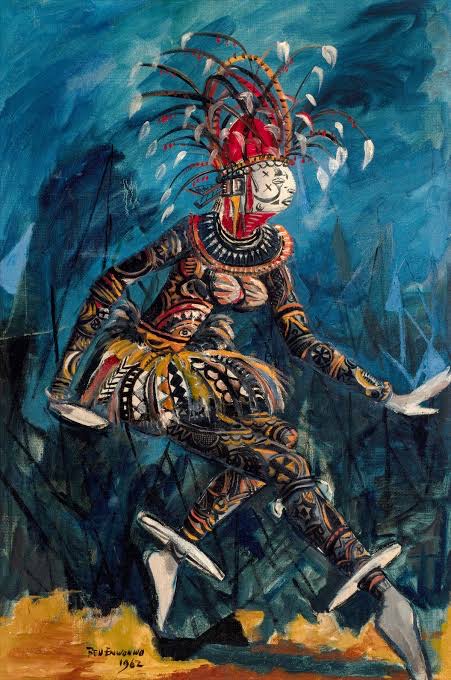


Ben Enwonwu, who lived between 1917 and 1994, is widely regarded as one of Africa’s most influential modern artists, whose work helped define, shape, redefine, and elevate African modernism in the 20th century. As both a sculptor and painter, Enwonwu fused traditional African aesthetics with Western techniques to create a distinctive and unique visual language that challenged colonial narratives and redefined African identity on the global art map.
Ben was born and trained in Nigeria and later at the Slade School of Fine Art in London. Enwonwu's early work was deeply inspired by the cultural heritage of the Igbo people, particularly in his elegant sculptures and symbolic paintings. He sought to reassert African dignity through art, portraying African figures with poise, strength, and spiritual depth, hawking them like gala. His sculptures, often carved in wood or bronze, were marked by fluid forms and a rhythm that echoed traditional masquerade and dance in his era, thereby beating his contemporaries.
One of Enwonwu’s most iconic achievements was his 1956 royal commission to sculpt a portrait of Queen Elizabeth II. He took the stage of painting, and that single outing brought him to the limelight until his demise. Again, the historic commission made him the first African artist to create an official portrait of a British monarch. The life-size bronze sculpture was unveiled in 1957, earning him international recognition and further cementing his status as a cultural bridge between Africa and the West. It also symbolized a moment of postcolonial transition, as Nigeria moved toward independence. One spectacular moment where an individual's achievement generates salutes from time to time. Africa is not only respected by the artistic offer but is also widely and globally recognized and respected.
However, Enwonwu’s role in shaping African modernism was profound, historic, unmatched, and unequal. He was a key figure in blending indigenous African themes with modernist principles, coining what some art historians refer to as “African humanism.” He often depicted dancers, royalty, and mythological beings, such as in his famous Negritude series, reflecting pride in Black identity, culture, and a Pan-African vision. His painting Tutu, a portrait of a Nigerian princess, has become one of the most celebrated and symbolic African artworks, often referred to as the “African Mona Lisa, which some artists capture in music.
Although his studio work served as a cultural diplomat, educator, and critic. Beyond this, he worked with UNESCO and was Nigeria’s first art adviser, influencing generations of Nigerian artists and policymakers. His legacy is visible today in the ongoing global recognition of African art and the reclamation of African narratives through visual expression, which accords Africans great respect and a sense of importance.
This makes him remain a towering figure in African modernism as far as it’s concerned. An artist who used brush and chisel not just to create, but to restore pride, provoke thought, and shape history to the astonishment of the white. Let’s not forget that his exhibitions in Europe marked a pivotal moment for African art on the global stage. His first major solo show in London in 1947, held at the Berkeley Galleries, introduced European audiences to modern African artistry beyond colonial stereotypes, racism, and segregation.
The exhibition was a success, drawing attention for its blend of traditional African forms and modernist techniques. His work traveled across Europe, with exhibitions in Paris and Rome, positioning Ben as a serious contributor to the international art scene. His presence challenged Western assumptions, proving that African artists could master and innovate within global artistic dialogues.
In Nigeria today, Enwonwu’s work carries profound cultural significance, which many hold in high esteem. Many see him not only as an artist but also as a cultural ambassador who honored indigenous traditions while presenting them in new, modern forms. His sculptures, such as Anyawu (the Igbo sun goddess), installed at the Nigerian National Museums, became symbols of national pride and spiritual resilience. The art reimagined African identity during a time of rising nationalism and postcolonial awakening. In Nigerian communities, his portrayals of masked dancers, royalty, and ancestral figures reflected a deep respect for cultural heritage. Yet, he also inspired a forward-looking vision, showing how African traditions could evolve and speak within modern global contexts. For many, his legacy lies in his ability to balance history with innovation, making him not just a celebrated artist but a visionary whose work still resonates across generations.
By and large, Ben didn’t only demonstrate mastery of art using his craft but also carved annals that have been dancing on the lips of Nigerians and the global communities when art is mentioned.
WRITTEN BY BENARD OKECHUKWU