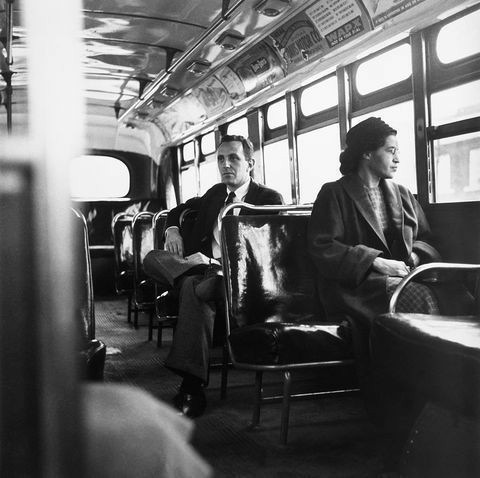
The Woman Who Sat Down to Stand Up - Celebrating the Enduring Legacy of Rosa Parks.
By Chinaza James-Ibe
“People always say that I didn't give up my seat because I was tired, but that isn't true. I was not tired physically, or no more tired than I usually was at the end of a working day. I was not old, although some people have an image of me as being old then. I was forty-two. No, the only tired I was, was tired of giving in.” — Rosa Parks in My Story
It was a cold December evening in Montgomery, Alabama, in 1955. Rosa Parks, a 42-year-old seamstress and longtime NAACP activist, boarded the Cleveland Avenue bus after a long day at work. She paid her fare and took a seat in the first row of the "coloured" section, just behind the ten seats reserved for white passengers. At first, she didn’t notice the driver—James F. Blake—the same man who, twelve years earlier, had left her stranded in the rain for refusing to enter the bus through the back door.
As the bus made its way through the city, it filled quickly. At the third stop, in front of the Empire Theater, several white passengers boarded, and soon, the whites-only section was full. Blake, following city law, moved the "coloured" sign further back and demanded that four Black passengers vacate their seats to make room for white riders. Three complied. Rosa Parks remained seated.
Tension filled the air. She recalled later that as Blake approached, waving his hand and ordering them to move, she felt a deep, unshakable determination calcified by the great injustice done to Emmett Till which she had recalled. She shifted slightly but did not stand. The driver demanded again. Parks quietly refused. When he threatened to call the police, she told him he could do as he pleased.
Within minutes, officers arrived. As they escorted her off the bus and placed her under arrest, she questioned why she was being treated this way. The officer’s response was blunt—the law was the law. But Parks knew this was about more than just rules. She later explained that her decision was not born of physical exhaustion but of something deeper—a fatigue from years of silent endurance. She had reached a breaking point, and she knew this moment would be the last time she allowed herself to be humiliated in such a way.
Parks was charged with violating Montgomery’s segregation laws and released on bail that evening. But the wheels of history had already been set in motion. Her arrest ignited the Montgomery Bus Boycott, a mass protest organized by local civil rights leaders, including a young Martin Luther King Jr. For over a year, Black residents of Montgomery refused to ride city buses, crippling the transit system and drawing national attention to racial injustice in the South. The boycott ultimately led to Browder v. Gayle, a Supreme Court case that ruled segregation on public buses unconstitutional under the 14th Amendment.
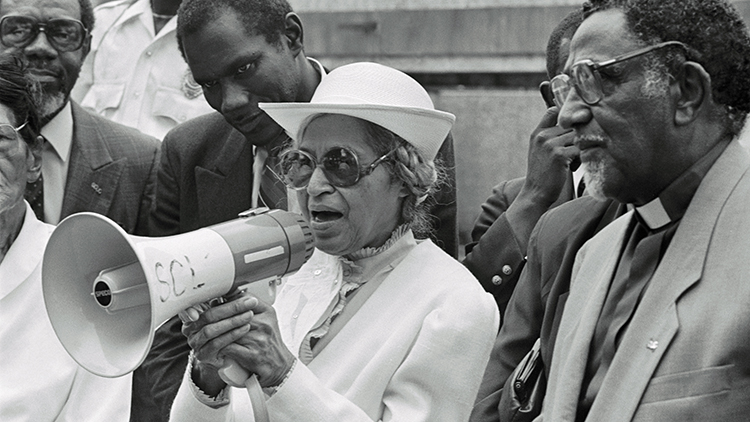
Though celebrated today, Parks faced severe consequences for her defiance. She lost her job, received death threats, and found it difficult to find work. Eventually, she and her husband relocated to Detroit, where she continued her activism. From 1965 to 1988, she worked as a secretary for Congressman John Conyers and remained deeply involved in the struggle for racial justice. She supported the Black Power movement, advocated for political prisoners, and worked tirelessly to ensure that future generations would not suffer the same indignities she had endured.
Rosa Parks' legacy extends beyond her famous refusal to give up her seat. Her lifelong fight for justice is explored in books such as Rosa Parks: My Story and The Rebellious Life of Mrs. Rosa Parks by Jeanne Theoharis. Films like The Rosa Parks Story (2002), Behind the Movement (2018), and Boycott (2001) offer further insight into her remarkable life and activism.
Her decision that evening was not just about a seat on a bus. It was about dignity, equality, and the right to exist without fear. A right to humanity.
Rosa Parks Day is observed on both her birthday, February 4, and the anniversary of her arrest, December 1, as a tribute to her legacy.