I've Waited More Than Time For You.
By Chinaza James-Ibe
Enitan,
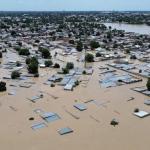
Four men are chasing after a floating body in the rain. Its clothes—a persimmon red polo with white peeling inscriptions at its back and navy blue sports shorts—are puffed like parachutes above the water. The men's feet are hidden in behemoth rain boots like little twin arks. I walk into the open market, and the person's name buzzes into my ears: Isaiah. Isaiah, the man built as sturdy as the newly erected Sacred Heart at St. Aloysius chaplaincy across the street. Isaiah, whose voice contrasted sharply with his stone frame—as thin as a clothesline—whose laughter flapped about his throat like colourful nightwear. Isaiah, who catcalled every fat-bummed lady in the market but never collected their numbers afterwards. Isaiah, who sold goat meat like a popstar—drumming with his blood-stained butcher knife—beatboxing as he sang his popular anụ ewu tune. Anytime I bought anụ ewu, I would find myself singing his song with my hoarse voice as I washed it in a bowl. Isaiah, who was like a chipmunk in the dry season—so alive and everywhere at once, without even leaving his stall. Enitan, the water has carried Isaiah too; he is not even the fifth person, but his voyage has shaken the market. The fufu sellers are clapping their hands as if the wind from it would dispel the flood at the roadside and bring Isaiah back. The vegetable sellers have turned the market into a makeshift ministry, shooting their hands into the air as if trying to drag God down by his robe to join the four men chasing Isaiah. Enitan, the water is a thief; every day is for it.
Yoriba is at my back, clinging to my skin like shrapnel, oblivious to this wet war about us and sucking her thumb noisily. I wish she were my mother, and I was at her back, sleeping. Once in a lifetime, we should switch places with our children. Don't you think so? When they have children of their own, it is just too late.
It's funny how a place changes. Amaraku is a maiden who is crying and ruining her makeup. The murk is her foundation. The begrimed puddles, her mascara. The beads of dirt are from the jewellery she has ripped out of grief. Amaraku is mourning: for days, her groom, the sun, has refused to touch her. She has torn her wedding dress and tries to seduce her groom with her wet, naked body. Enitan, Amaraku is mourning, and when a mother mourns, her child suffers for it. With her tears, she has unwittingly swept her children into oblivion: first, it was Ajah, the shoemaker; then it was Ukairo, the nurse; Patience, the tailor; then Ugada, the palm oil dealer; Anulika, who hawked Ori; now, Isaiah.
Amaraku’s roadside is a crime scene. Filicide. The culprit meanders. We, the surviving children, are marching without raising our legs so we don't get swept away by her deluging sorrow. The roadside is like this because Gov. Okorocha was so kind and constructed a ‘sparkling new’ road mostly by pouring black paint over the flimsy constructions he made in the previous years. Okorocha, who always drove by Amaraku during the dry season, would suddenly take ill during the rainy season and be flown to some exotic country. Okorocha with his funny grey whiskers and fart-filled belly.
Two capsized trucks are being evacuated. If the men carrying out this operation are not careful, they will be evacuated as well. The fear is rabid in their eyes, and they begin to shout at each other when all they mean to say is ‘I'm scared too’. Coca-Cola bottles are dancing in the flood. Some are filled with muddy water, some with coke, and others with both. Children perched on their half-submerged fences are throwing paper boats into it as it rages by. Their mothers are screaming: two children fell from the fence last week and were carried away. Theirs were the only bodies that were not found deposited at Adada. It was rumoured that the goddess of Adada had adopted the dead children. Adada is where Amaraku takes all her sorrow. Adada is the mother of Amaraku, and that is what mothers do: overflow with another's grief.
Fathers leave. Husbands leave their lips on yours. Then they leave their seed in you. Then they leave their hands on you. Then they leave, like you have done, to seek paradises to channel home. Then they leave this life—baptize you a widow. Fathers leave, but they never say, ‘Don't wait for me’. They'll leave a part of them with you, and you have to carry it for the rest of your life. Mother! You will ration the scent they left on your wrapper, you will ration the memory of their touch, and you will smear your body with dregs of their voice after every bath. You will never know that he has been made complete elsewhere. Enitan, the sun was an overripe paw-paw when you left; now it is a drop of vegetable oil floating on water. I still carry a bit of you with me; if you don't need it anymore, please tell me where I can drop it.
Enitan! Yoriba is two years old now, and she was nothing when you left. Tomorrow, Isaiah will be found at the banks of Adada, now 100 per cent fluid. Unlike the sun, the four men have returned to the market. Like the sun, their spirits are shrunken. As I leave the market empty-handed, I hear the vegetable women wailing and tugging on God's robe. You made us out of dirt does not mean we're dirt, Osebuluwa!
I swat at the buzzing voices and walk towards the roadside. Yoriba is still asleep.
“Nne, your baby is falling ọ! Tie her well.”
This voice awakens the rage in me. I am a mother like Amaraku, not a mother like Adada. I cannot. I am not the shrunken sun; I am the tears of Amaraku. I have waited for you more than time. More than every season waits for its turn. Enitan, I have carried shrapnel on my back and crawled from year to year. To stop the bleeding, I must first extract the metal. Enitan, you have made me sturdier than Isaiah. I am so heavy, all I do is sit and wait for you while my people die by the seasons. Tomorrow, the flood will carry more than Isaiah—it will carry tons of hope. The market will drown. People will perch on their roofs to pound fufu for dinner. And then the farms will drown. People will settle in their liquid coffins, and oh, their bellies will be filled with water. They will never be hungry again.
“Nne, oga adapụkwa!”
Enitan, Ebe?
Two Ubemgba hawkers are coming towards me. They are alerted by my apparent madness. A mother is always this close to madness. She loses her mind to everything that has been in and out of her.
I am in the middle of our liquid street when I loosen my wrapper and let Yoriba fall.
Image credit: Freepik